
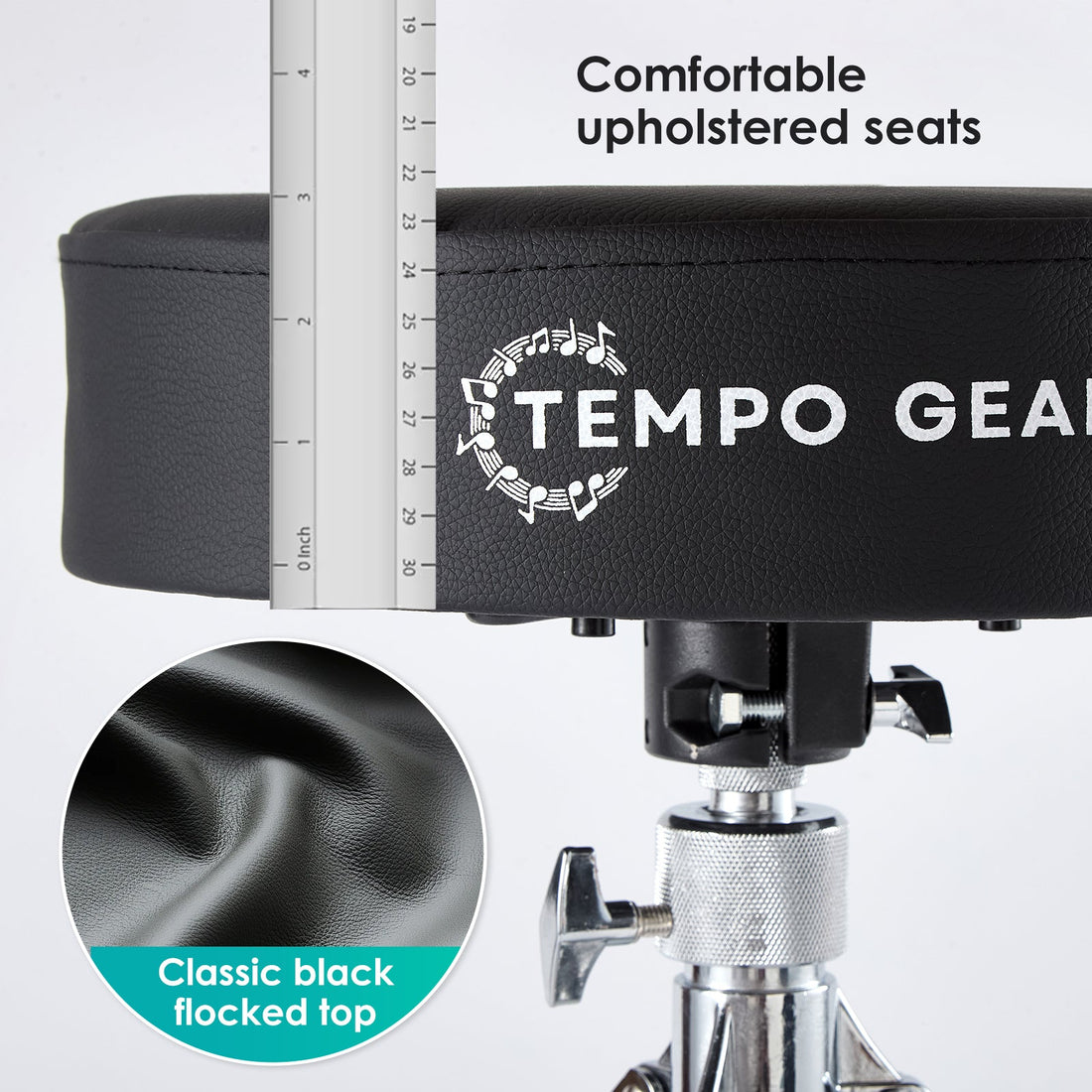
There is no single drum stool that is best for every player. The useful question is which seat shape, adjustment system and base suit your body, kit and routine. This 2026 guide gives Australian shoppers a practical way to compare drum stools and drum thrones without relying on rankings, unverified reviews or changing price claims.
If you want to see the models currently listed by Tempo Gear, start with the drum stools and drum thrones collection. Product availability can change, so check each product page for its current status and specifications.
Quick comparison checklist
Before comparing models, write down these six requirements:
- Usable height range: the seat must adjust to a position where you can reach both pedals without stretching or crowding your legs.
- Seat shape: choose between a familiar round top and a contoured or saddle-style top.
- Adjustment method: compare threaded spindle, pin-and-bolt and hydraulic systems by how they lock and how often you expect to change height.
- Base: check the leg layout, braces, feet and the space the base occupies around pedals and stands.
- Transport: confirm folded size and listed weight if the stool will move between rehearsals or venues.
- Optional support: decide whether you want a backrest and verify how it adjusts or removes.
Measurements matter more than labels such as beginner, professional or ergonomic. Two products can use the same label while having different seat widths, height ranges and mechanisms.
Round seat or saddle seat?
Round drum stools
A round top is the traditional format. It offers an even edge in every direction and may suit players who like to turn on the seat. Compare the diameter, padding depth and edge shape rather than assuming every round stool will feel alike. A larger top occupies more room and supports a different area than a smaller one.
Saddle-style drum thrones
A saddle-style top has a shaped front and a more defined sitting position. Some players prefer that contour; others prefer the freedom of a round top. The word "saddle" alone does not tell you the width, padding or angle, so use the product photographs and listed measurements together.
If you cannot test a seat in person, compare its measurements with a chair or stool you already use. That simple reference is more useful than choosing from a category name alone.
How to compare height-adjustment systems
Threaded spindle
A spindle system changes height by rotating the seat or post. It can allow small increments, but you should still check how the chosen height is secured. Look for clear product photographs of the locking components and follow the assembly instructions supplied with the model.
Pin, bolt or clamp adjustment
Some stools use fixed holes, a bolt or a clamp. These systems can be straightforward, but the available increments may be wider than on a threaded post. Confirm that one of the listed settings falls inside your required range.
Hydraulic adjustment
A hydraulic model uses a lever to change height. This may be useful where several players share one kit or frequent changes are expected. Compare the listed adjustment range and base dimensions just as carefully as you would with a manual model.
Whichever system you choose, test the lock before playing. If the seat rotates, drops or wobbles unexpectedly, stop and check the assembly and fasteners.
Base stability and pedal clearance
The stool base must share a crowded floor with a kick pedal, hi-hat stand and other hardware. Check:
- whether the legs are single- or double-braced;
- where the rubber feet will sit on your floor or mat;
- whether the legs fold and how the folding joints lock;
- the space between the centre post and the nearest pedal;
- any listed user-weight limit on the current product page.
Do not estimate a weight limit from photographs or from another model with a similar frame. Use only the specification published for the exact product you are considering.
When a backrest belongs on the shortlist
A backrest changes the stool's footprint, transport size and available movement. If you are considering one, check whether its height, depth or angle can be adjusted and whether it can be removed. Also compare the space behind the kit: a backrest may need more clearance from a wall or rack.
A backrest is a preference and setup choice, not a medical treatment. If sitting or playing causes persistent pain, seek advice from a qualified health professional rather than choosing equipment from a general buying guide.
Current Tempo Gear formats to compare
The current collection shows several different formats. The following is a specification-led shortlist, not a ranking. Check each linked page for current availability and the latest product details.
| Format | Current model | Details to compare |
|---|---|---|
| Compact round seat | Round Adjustable Drum Stool 28cm | 28 cm seat format, adjustment points, folded size and base placement. |
| Larger round seat | Drum Stool Ergonomic 32cm | The page lists a 32 cm round seat, 43-65 cm adjustment range and a folding tripod base; confirm all current specifications before ordering. |
| Contoured seat | Ergonomic Saddle Seat Drum Throne | Saddle contour, listed height range, adjustment method and space around the front of the seat. |
| Seat with backrest | Ergonomic Drum Throne With Backrest Hydraulic Adjustable | Hydraulic range, backrest adjustment, base footprint and current availability. |
A five-minute fit test
- Place the stool first. Set it where your feet can reach the kick and hi-hat pedals without the base touching either stand.
- Choose a starting height. Sit so your feet rest on the pedals and your knees are not crowded against the kit.
- Check balance. Lift each heel and operate each pedal separately. You should not need to grip the seat edge or lean heavily to one side.
- Check reach. Reach the snare, toms and cymbals without repeatedly sliding forward on the seat.
- Repeat after a short session. Recheck every lock and note any pressure point or restricted movement before deciding the setup is right.
For a detailed setup sequence, use the drum stool setup guide. For definitions and a broader overview of seat types, read the complete drum stool guide.
Questions to ask before buying online
- Are the seat diameter or width and the height range clearly listed?
- Does the product page show the exact adjustment and locking system?
- Are the folded dimensions and weight listed if transport matters?
- Is a backrest included, optional or unavailable?
- What components are listed as included in the package?
- Is the product currently available?
Keep screenshots or a copy of the specifications you used for comparison. Product listings can change, and the model name alone may not capture a revised measurement or included component.
Which drum stool is best for your setup?
The best drum stool for your setup is the one that fits your measured height requirement, gives your preferred seat shape, locks securely, clears the surrounding hardware and matches your transport needs. A backrest or hydraulic lever may be useful for one player and unnecessary for another.
Use the checklist first, then compare the current drum stool collection by published specifications. That approach creates a defensible shortlist without depending on unsupported "top rated" claims or a price that may already have changed.


